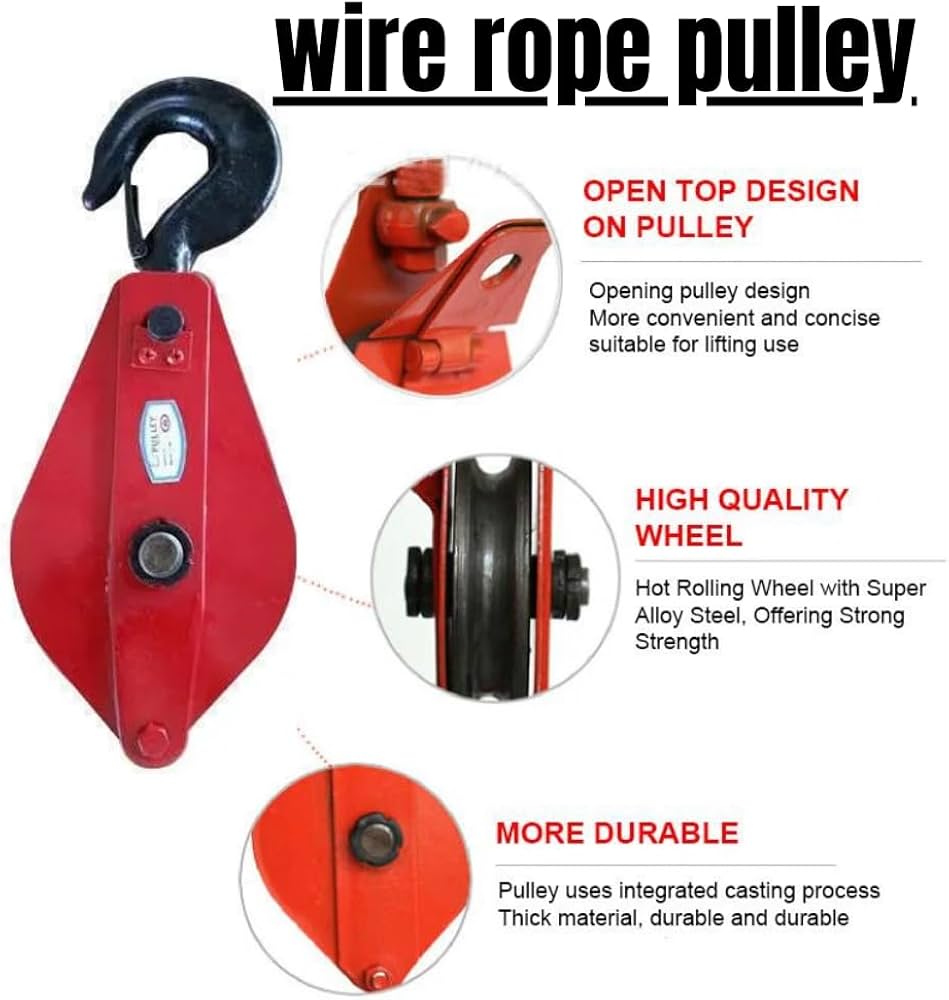


Description
Product details
Pulleys are an essential component in rigging systems, used to lift and move heavy loads. There are several types of pulleys, each designed for specific applications: Single Sheave Pulleys: These pulleys have one wheel or sheave and are used for basic lifting tasks. They are available in various sizes and materials. Double Sheave Pulleys: These pulleys have two wheels or sheaves and are used to increase mechanical advantage and reduce the force required to lift a load. Snatch Blocks: Snatch blocks are single sheave pulleys with a hinged side plate that allows the rope to be quickly inserted or removed. They are commonly used for changing the direction of a pulling line. Becket Blocks: These pulleys have an additional eye or hook (called a becket) on one end of the frame, allowing for multiple parts of the rope to be attached to the block. Swivel Blocks: Swivel blocks can rotate 360 degrees, allowing the load to turn without twisting the rope. They are useful for handling loads that may spin or sway during lifting. Tandem Blocks: Tandem blocks are two pulleys connected together, allowing for a greater mechanical advantage and the ability to handle heavier loads. Key Considerations When Choosing Pulleys When selecting pulleys for a rigging system, consider the following factors: Load Capacity: Choose pulleys with a working load limit (WLL) that exceeds the weight of the load being lifted. Rope Size: Match the pulley's sheave size to the diameter of the rope being used to ensure proper fit and performance. Material: Pulleys are typically made from steel, aluminum, or high-strength plastics. The material choice depends on the application and environment. Sheave Design: Look for pulleys with sheaves that have smooth grooves to minimize wear on the rope. Bearings: High-quality bearings, such as ball bearings or roller bearings, provide smooth operation and reduce friction.