

Description
Product details
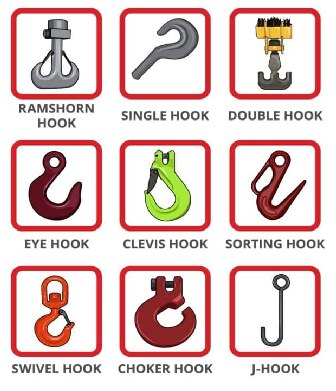
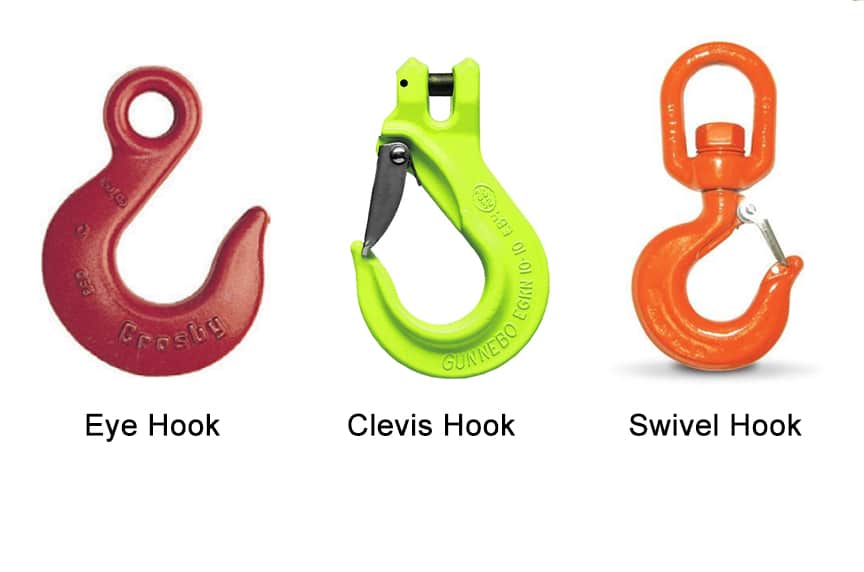
Lifting hooks are essential components in rigging systems, designed to safely lift and secure heavy loads. They come in various types, each suited for specific applications and load requirements. Here’s an overview of the different types of lifting hooks and their uses. Types of Lifting Hooks : Eye Hooks: These hooks feature a loop (or eye) for attaching to slings or chains. They are often used in light-duty applications and provide flexibility in movement. Clevis Hooks: Designed with a U-shaped clevis that is secured with a pin or bolt, these hooks offer a non-permanent connection, making them easy to replace if damaged. Swivel Hooks: Positioning Swivel Hooks: Allow for alignment during connection but do not rotate under load. True Swivel Hooks: Equipped with bearings, these hooks can rotate freely under load, preventing twisting and enhancing load stability. Grab Hooks: Designed with a narrow throat, grab hooks are used to hold or shorten chains. They come in two types: Standard Grab Hooks: Require a reduction in working load limit (WLL) when used. Cradle Grab Hooks: Provide better support for the chain link and typically do not require a WLL reduction. Sorting Hooks: Used for sorting and organizing materials, these hooks are designed to engage at specific angles (30° to 45°) and are often latch-less. Foundry Hooks: Commonly used in high-heat environments, these hooks have a wide throat for fitting trunnions and are designed for handling molds or castings. Drum/Barrel Hooks: Specifically designed for lifting barrels or drums, these hooks have a wide end that fits under the lip of the barrel and are typically used in multi-leg sling assemblies. J-Hooks: Slimmer and lower profile than traditional hooks, J-hooks are suitable for tight spaces and have a lower WLL due to their design.